
Quick Guide to the Cinque Terre
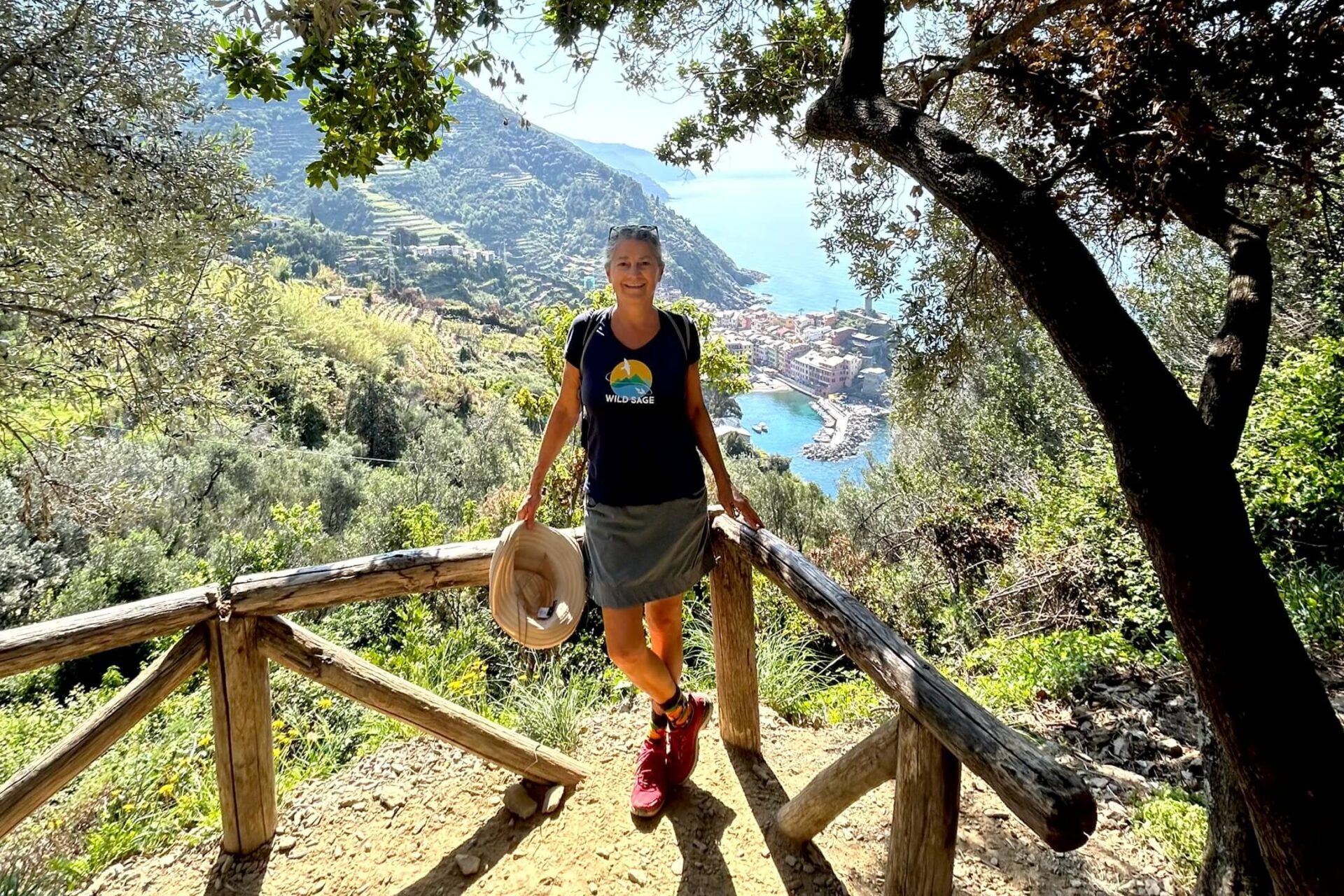
Most people have heard of the five small villages that make up Italy’s “Cinque Terre” (literally “five lands”) but probably don’t know much about them. This quick guide to the Cinque Terre will explain their history and describe the hiking trails that join them.
Quick Guide to the Villages of the Cinque Terre
The Parco Nazionale Cinque Terre Area Marina Protetta is a National Park and Protected Marine Area that comprises the villages of: Monterosso, Vernazza, Corniglia, Manarola, and Riomaggiore. The area is also part of a UNESCO World Heritage site, together with nearby Portovenere and its islands. The area’s residents built terraces along the rocky hillsides using a dry-stone wall technique that requires no mortar, allowing them to grow olives, grapes, and other crops that eventually made them a key part of the Genoese Republic.
Short Historical Background
This part of the coastline is in the Italian region of Liguria and was originally inhabited by Ligurian (and then Celto-Ligurian) tribes before becoming part of the Roman Empire. The Romans established small ports where they found fresh water and a safe harbor as part of their conquest of the peninsula. The ports were usually “twinned” with upper towns that were built high on the hillside for protection in case of attacks by sea. People moved from the high towns down to the coast when the area came under the Republic of Genoa, which granted them protection in exchange for their loyalty in trade and battle. This stretch of coast is so steep and rocky that the people remained virtually cut off from the surrounding area until a train line was built in 1870! Roads followed, but not until the 1950s, and still now it’s hard to get in by car since the roads are narrow, very curvy, and there’s not much parking once you get to your destination.
1) Monterosso al Mare
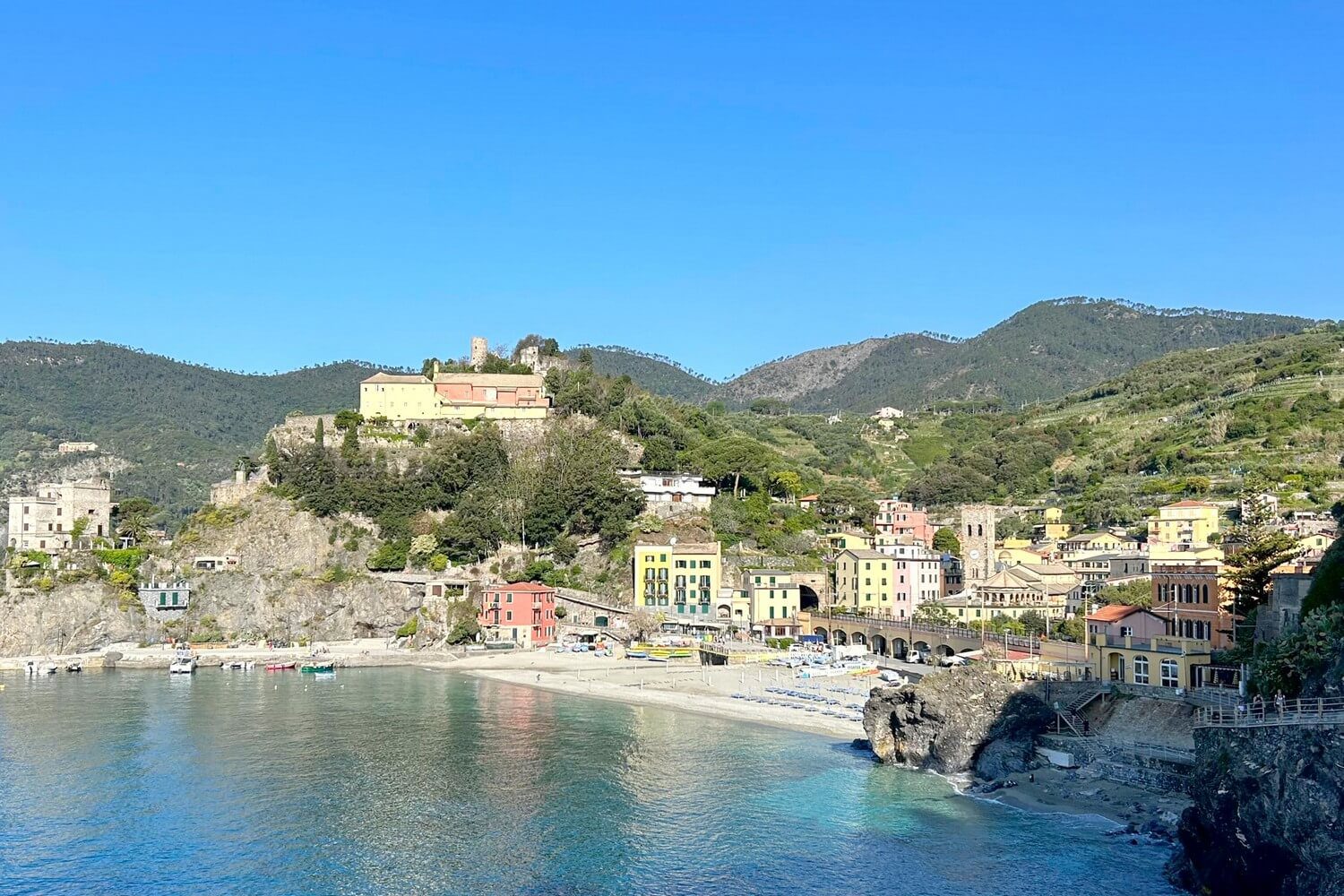
Monterosso is the largest of the five towns and has a sandy beach, so it’s a popular destination. There’s a wide variety of accommodation choices, between Monterosso “vecchio” (the old town, seen here above) and the new part of town. The new town was built in the 1950s when they needed to build a train station, and it also has a sandy beach.
Things to see in Monterosso: take a swim or relax on the beach. See the beautiful 13th century church with a striped marble facade and interior. Next to the church is a chapel dedicated to the “Brotherhood of the Blacks,” who tended to the dead and the dying during a plague outbreak in the 1600s. Walk up to the Capuchin Monastery for great views, plus a look at an altarpiece by Flemish master Van Dyck.
2) Vernazza
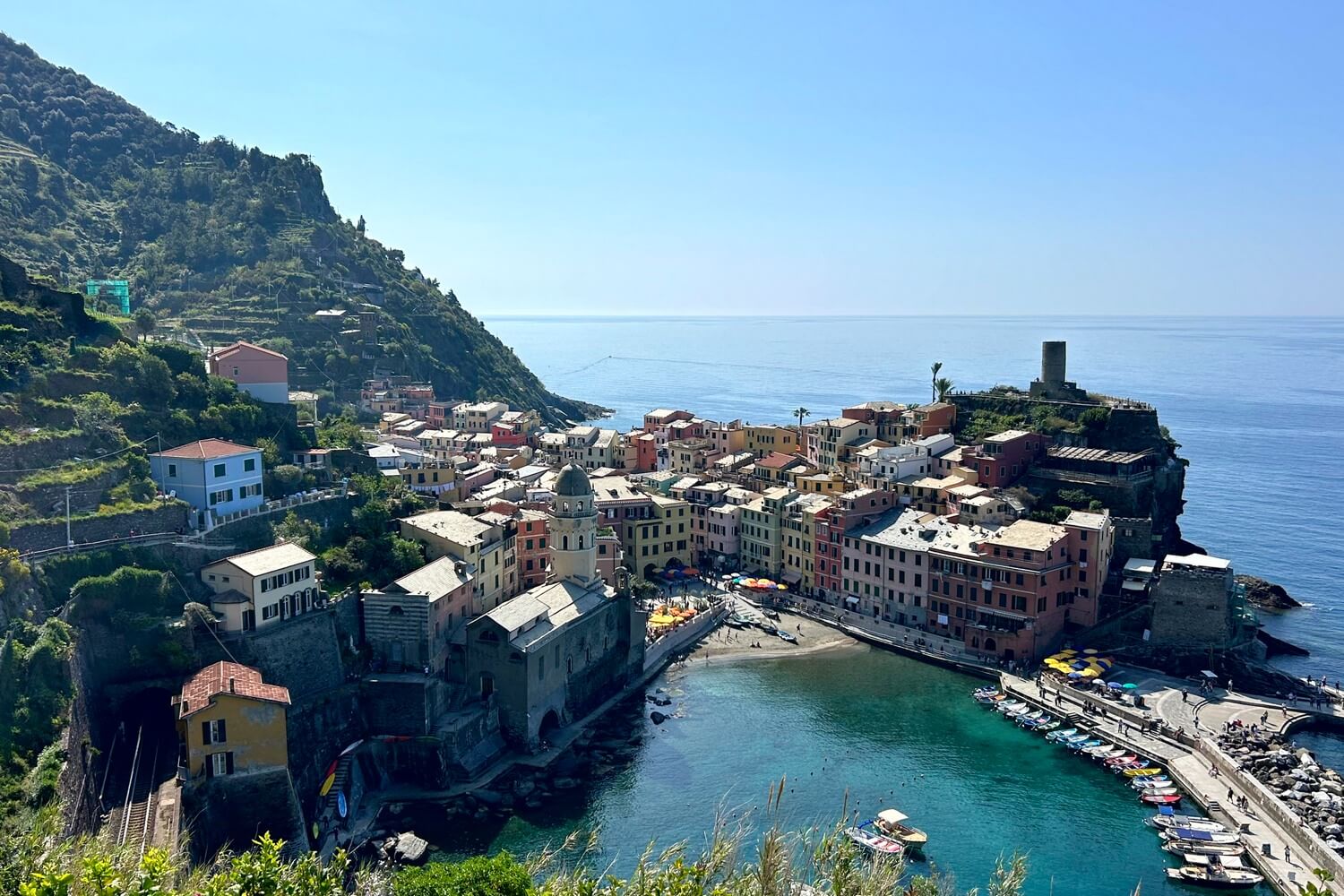
Often considered the “prettiest” of the towns since it’s so postcard-perfect. Even the train station is tucked up at the top of town and is barely wide enough to let light in before the train disappears into a tunnel. In a way it’s a victim of its own beauty as it can also be extremely crowded. Vernazza was praised early on by travel writer Rick Steves, who recommended it over the other towns and suggested people go to “the cafe with the yellow umbrellas.” Now you have to fight the tourists to get a seat, but you can’t deny the town is cute! It doesn’t have a sandy beach but people swim from the jetty and the rocks in the summer.
What to see in Vernazza: walk along the main street and peruse the shops or grab a piece of focaccia. Climb the ancient tower (for a small fee) for great views. Even if you’re not going to hike the trails, walk up the stairs on both side of town for amazing photo ops.
In popular culture: Pixar’s 2021 animated movie “Luca” is based loosely on Vernazza and other villages. Read more about it and see some comparative images in Claire’s personal blog.

3) Corniglia
Corniglia (pron. “Cor-NEE-lia” — the G is silent) is the only one of the villages without water access. The town is fairly small, and in order to reach the train station you have to walk down some 380 steps (or UP if you’re coming by train). The stairs are graded gently so it doesn’t feel steep, or there is a bus that shuttles between the town and the train station. You can get tickets on the bus or at the train station. Note: this is the only town where the ferries don’t stop.
What to see in Corniglia: walk down the narrow main street and peruse the shops and cafes. There’s a tiny main square with a few outdoor cafes. Walk all the way to the end for an overlook with views over both sides of the coast. There’s also a beautiful Medieval church in the “outer” part of the town (you can see the church spire on the right side of the photo above).

4) Manarola
Manarola is a popular choice for young travelers. In recent years it has become a “social media darling” since a popular cafe offers photo ops and spritzes from across the bay. It doesn’t have a sandy beach but has good swimming from the rocky bay (left side of the photo above) or via the boat ramp. The lower town sits on a rocky spur then the village continues up the hill to a small square and the main church. The train station is through a short tunnel since there was no room to put it in the old town. The famed “Via dell’Amore” — a flat and flag-stoned walking path — starts from beyond the train station. The ferry stops around the back of the town, as in the photo above.
What to see in Manarola: walk down the main street and down to the waterfront for views or swimming. Continue walking around the promontory to get the view back onto the town (as above). Walk up the main street to the higher part of town to get out of the crowds in the lower town.

5) Riomaggiore
Riomaggiore’s narrow main street works its way up the hill with the usual shops and restaurants. The best view of the town is from the port, which you access via a small flight of stairs. The Via dell’Amore connects to Manarola past the train station, so it connects to the town via a tunnel. This is the last town on the train line before the big city of La Spezia, so people coming from the south often start their journey here.
What to see in Riomaggiore: walk out to the colorful port for views. If you’re a hiker, there’s a wonderful trail out of Riomaaggiore that goes over to Portovenere, a town beloved by the British Romantic poets.
In contrast, see what Riomaggiore looked like in the late 1800s. It was extremely poor and life was very hard. See also this amazing video filmed in 1943 (from minute 7.5 you see them building the trail above Vernazza)!

Quick Guide to Hiking the Cinque Terre

Say what you want about the Cinque Terre (mainly, “it’s too crowded!”), it’s pretty extraordinary how this hiking trail has captured the imagination of travelers! Before a series of devastating landslides in the ’00s, you could hike all four trails in a row: two challenging ones (Monterosso to Vernazza and from there to Corniglia) then two easy ones (Corniglia to Manarola and then on to Riomaggiore). Unfortunately, the Corniglia-Manarola trail kept getting washed out so it’s permanently closed. There’s a high trail (up to 330 m/1,083 ft) but it’s pretty challenging, so not for everyone. The Via dell’Amore path has just re-opened after 15-years of renovation, but it’s so crowded they let in up to 400 people PER HOUR and can be one-way only in peak season.
The trails of the Cinque Terre:
- Monterosso to Vernazza: steep up on stairs and rocky trail, short traverse, steep down on rocky trail (1.5-2 hrs walking)
- Vernazza to Corniglia: steep up on trail, short traverse, steep down on rocky trail (1.5 hrs walking)
- Corniglia to Manarola (via “the high trail): long steep uphill on rocky trail, beautiful traverse through the vineyards, long steep downhill on steps and rocks (2.5-3 hrs walking)
- Manarola to Riomaggiore: the “Via dell’Amore” or “Path of Love” was so named since it was a short and flat path that allowed lovers to meet away from prying eyes. It became synonymous with the Cinque Terre as a whole since it’s accessible to everyone, when in reality it’s only 900 m (~ a half-mile) and totally flat! You now need a separate ticket and will have to reserve your timed entrance.
If you enjoyed this quick guide to the Cinque Terre, you can see it in person with us on our Cinque Terre & Liguria Tour or as the final leg of our Italian Highlights Tour. Or ask us to organize a customized tour for you. Contact us for details!
🍋🍋🍋
Frequently Asked Questions About the Cinque Terre:
1) Can you visit all five towns of the Cinque Terre in one day?
Yes, BUT. You can see all five towns in one day though it will be rushed. If you wanted to HIKE between all of them, it will take 7-8 hours (unless you’re in great shape and you go very fast!). You can take the train between the towns as each journey takes just a few minutes. You can also take the ferry between them as it stops in every town except for Corniglia. One popular idea is to train-hop one way and then take the ferry back. Note: the ferries don’t run if there are choppy seas!
2) What are some traditional foods from the Cinque Terre?
Liguria and the province of Genoa are known for delicious treats like focaccia, pesto, fresh seafood, and a chickpea-flour flat-bread called farinata. You also find the sweet lemon liquor commonly called (erroneously) “lemoncello.” To be correct, “limoncello” is from the Amalfi coast while the version here is “limoncino” — but you can call it what you want! 😉
3) What is the nicest village in the Cinque Terre and/or the best to stay in?
This is hard to answer since people want different things on holiday. Monterosso is the largest, so offers the best lodging and food options. It also has the only sandy beach and more train connections. The purely “cutest” is probably Vernazza; the quietest is probably Corniglia (since it has no water access). Manarola is the next biggest behind Monterosso so has lots of B&B options (though few actual hotels), and Riomaggiore also has a few B&B and hotel options.
4) Is the Cinque Terre really touristy?
In a word: YES. We’ve been coming here for 30 years and we’ve seen it transform from relatively quiet to an overwhelming place where you can barely walk down a street or find space on a train. For this reason, we recommend going in a “shoulder season” (early spring, late fall).
5) Can I do the Cinque Terre as a day-trip from Florence?
Technically YES but it will be a long day. The quickest trains take 2-3 hours while some take up to 4 hours. Driving also takes 2.5-3 hours, depending on traffic. So as a day-trip you’re looking at at least 5 hours of traveling, which doesn’t leave a lot of time to see the towns. But yes, you can do it and you could see Monterosso and Vernazza, for example, with time to do one hike.
6) Which airport is closest to the Cinque Terre?
The Pisa Airport is a great choice since it receives flights from around Europe, including the low-cost carrier RyanAir. From there it’s a 1-1.5 hour train ride, depending on which town you’re going to. The next closest airport is Genoa (Genova in Italian), which will also take 1-2 hours by train (depending on the train and which town you go to).
If you enjoy coastal hiking, you might also like these tours:
- Portugal: Algarve Coast Walking Tour
- Greece: Athens & Island Explorer
- Sardinia: Hiking Through History
- Naples & the Amalfi Coast
- Sicily Hiking & History Tour
- Puglia: The Spectacular South
Article by Claire Duiker and Emanuela Angelini, Wild Sage co-founders